A Federal Energy Management Program Award Winning Framework

What is an ICES?
An ICES is a network that allows for the interconnection between multiple microgrids, other forms of power generation (ex. EV-to-grid power), and the main utility power grid. The unique integration of an ICES provides additional value over small-scale microgrids that are often fully islanded from the main grid and have difficulty scaling to meet the needs of ICES consumers.

Specifically, ICESs are designed to optimally serve both critical infrastructure and the community that supports it, with system design tailored to the specific needs of its consumers to offer higher quality power, lower costs, and adaptable generation options.

Compared to standalone microgrids, ICESs:

  • Better account for and integrate the complex, dynamically shifting needs of each consumer and stakeholder of the ICES
  • Easily scale to systems from small to very large capacity depending on each project’s demand requirements
  • Offer greater flexibility and control to dynamically optimize where power is flowing in the system and increase efficiencies through demand side management

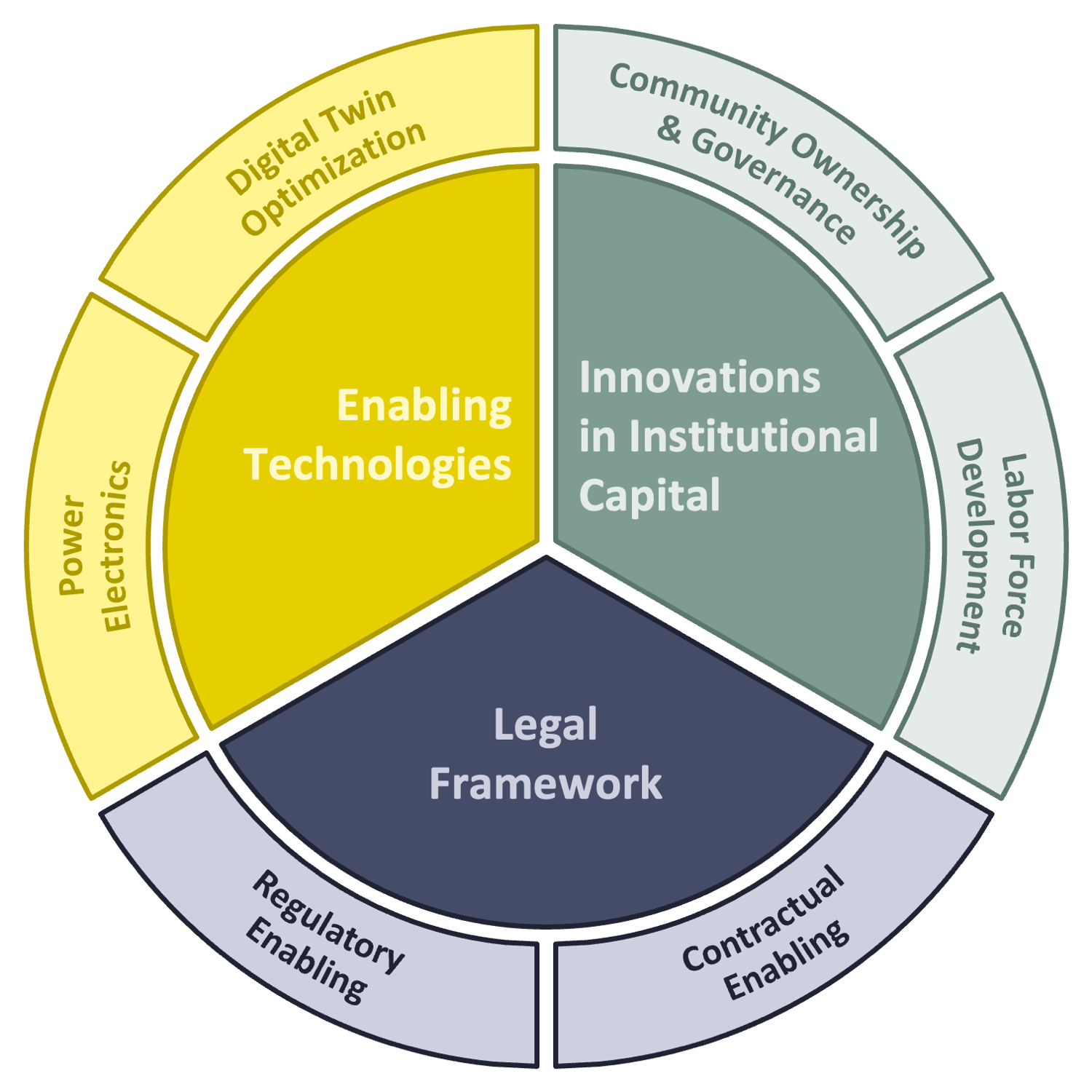
The ICES Framework

Given the inclusion of technological, institutional, and legal innovations in an ICES that need to handle high levels of complexity and competing needs of participants, Pareto Energy developed the ICES Framework to guide the design, build and operation of ICESs in the most optimal way for all participants. Benefits of the Framework include:

  • Standardized process that is clear and easy to follow
  • Explicit terms and expectations for all stakeholders throughout the design, build, and operation of the ICES
  • Flexibility and adaptability to variety of available energy solutions, project sizes, specialized consumer needs, and new innovations
  • Established protocols for data privacy for each ICES stakeholder and enhanced cybersecurity

All of the technologies, approaches, and concepts in the ICES Framework have been implemented in four community energy systems serving critical infrastructure in New York City and in numerous community energy systems in Europe. Our innovation is to integrate these elements into one optimized design framework for project success.

Enabling Technologies

  • Power Electrics

    Off-the-shelf hardware to seamlessly and non-synchronously integrate microgrids and other generation in the ICES with each other and the main grid, solving the problem of synchronous electro-mechanical interconnection that cannot island to provide uninterrupted power. Advanced power electronics reduce the cost and time required for interconnection approvals and enable revenue opportunities to sell power and services back to the grid.

  • Digital Twin Optimization

    Open-source software for optimizing ICES design and operation with distributed optimization of multiple ICES actors or agents, each with multiple objectives. During ICES design, the digital twin uses data streams from previously installed microgrids and supports labor force training and cybersecurity testing. After design, the digital twin operates the ICES (i.e. real twin) with day-ahead model process control and day-of error correction.

Innovations in Institutional Capital

  • Community Ownership & Governance

    Incentive structure for the ICES to function as a common pool resource where the labor that builds the ICES and the community that uses it owns and governs the system, opening up access to better third-party financing options and other benefits for all participants in the system.

  • Labor Force Development

    Formalized program to address gaps in readily available labor for microgrid design, build, and operation to ensure that critical infrastructure operators have access to a sufficient workforce, and local residents are provided development, apprenticeship, and training programs. Regularly skilled and highly skilled labor are developed in collaboration with trade unions and university think tanks, respectively.

Legal Framework

  • Regulatory Enabling

    Legal backbone of the ICES that provides guidance and assurances to system participants and stakeholders, ensuring equitable energy distribution, maximizing returns, driving efficiency and increasing community reliability.

  • Contractual Enabling

    A set of standardized contracts and agreements that set the “rules of the game” based on a series of legal contracts including: Utility Agreement, Purchased Energy Agreement, Engineering-Procurement-Construction Contract, Community Benefits Agreement, Operating Agreement.

Through the Framework, stakeholders are enabled and empowered to…

  • Utilities

    • Alleviate congestion on main grid by offloading demand from ICES consumers
    • Access additional electricity supply and ancillary services from the ICES through interconnection agreements
    • Meet strategic goals, commitments to consumers and other stakeholders, and mandates related to enabling greater adoption of distributed generation and lower emissions
    • Build goodwill with local communities and government

  • Critical Infrastructure Operators

    • Recoup investments and generate revenue from ICES operational activities and selling of electricity and services back to the grid
    • Access trained and readily available labor force for the design, build, and operation of the ICES
    • Optimize the ICES system to their specialized energy needs while also reducing overbuild and redundancies common with traditional microgrids and other distributed generation
    • Access to local and state incentives and other benefits related to Community Benefits Agreements (CBAs) with the city

  • Community

    • Actively participate in ICES design, decision making, and gains through ownership and governance structure
    • Enjoy higher quality, more reliable power that can also address community imperatives like air quality and water access
    • Grow other parts of the community through positive externalities from the ICES (ex. educational programs at local schools, increased investment interest in area, labor force development)

  • Labor Force

    • Actively participate in ICES design, decision making, and gains through ownership and governance structure
    • Gain niche expertise in critical area of infrastructure labor
    • Access certification programs and opportunities to upskill within the growing energy labor market
    • Rely more on long-term employment options related to ICES build and operation as opposed to short-term construction roles

  • Investors

    • Access incentive programs related to community development and improvements
    • Benefit from increased participation from investors like union labor pension funds due to active role of labor force in the ICES
    • Address traditional concerns from microgrid investors like timelines, revenue generation, and project risks (ex. no return on investment in design stage when projects fall through)

  • Government

    • Model successful PPPs for future projects
    • Meet goals and mandates through privately funded projects
    • Utilize ICES to test and prove updates to regulations